# South China Sea: A New Flashpoint in the Making **Published: 2026-04-21**
The South China Sea has entered a volatile new phase in April 2026, with an unprecedented series of joint naval exercises met by China's increasingly assertive countermeasures. This escalation marks a critical inflection point, threatening to disrupt global trade, accelerate a naval power competition, and fundamentally reshape regional alliances. As warships from multiple nations patrol contested waters and new physical barriers appear on disputed reefs, the risk of miscalculation is reaching a new peak, placing the region's stability on a knife's edge.
### The Spark: Joint Drills and Beijing’s Response
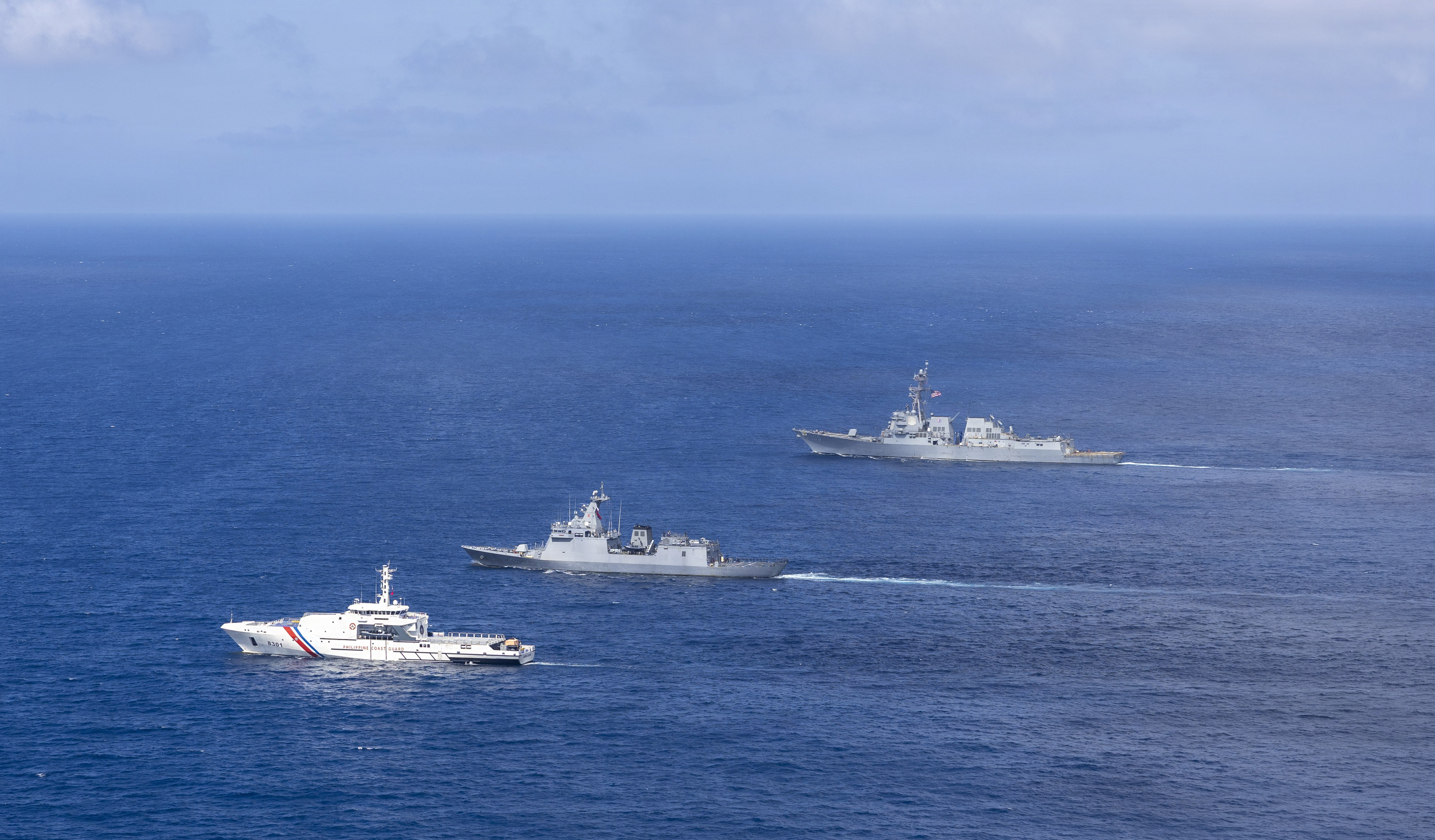
In early April 2026, the United States, Australia, and the Philippines conducted their second joint maritime exercises of the year, involving warships, fighter jets, and surveillance aircraft in a demonstration of deepening defense cooperation (Source 1, 3). These drills were a prelude to the much larger annual Balikatan ("shoulder-to-shoulder") war games, which commenced on April 20. The 2026 Balikatan exercises are historically significant, involving over 17,000 troops and, for the first time, Japan as a full participant rather than an observer (Source 1, 8). Japan’s participation, enabled by a 2024 Reciprocal Access Agreement with the Philippines, underscores a strategic shift in Tokyo's regional security posture (Source 1, 7).
Beijing has responded swiftly and forcefully to what it perceives as provocations by "external forces" (Source 1). China's Foreign Ministry warned that nations "blindly binding themselves together in the name of security" are "playing with fire" (Source 8). Beyond rhetoric, China has taken concrete action. Satellite imagery from April 2026 confirms that China has deployed a floating barrier and multiple coast guard and maritime militia vessels to block the entrance to Scarborough Shoal, a traditional fishing ground within the Philippines' exclusive economic zone (Source 2). This move represents a significant escalation from previous harassment tactics to a direct physical blockade (Source 2).
### The Stakes: A $5.3 Trillion Artery at Risk
The South China Sea is not merely a site of territorial contest; it is a vital artery for the global economy. An estimated $5.3 trillion in commercial goods, representing up to one-third of global trade, passes through these waters annually (Source 4). The waterway is also critical for energy security, handling 45% of global crude oil shipments and 42% of propane (Source 4).
An armed conflict in the region would have catastrophic economic consequences. Economic models project that a conflict forcing the rerouting of shipping around Australia would trigger a global economic shock (Source 4, 5). Regional economies would be hit hardest: * **Taiwan:** Could see its GDP contract by as much as 33% (Source 4). * **Singapore:** Faces a potential 22% drop in its economy (Source 4). * **Hong Kong, Vietnam, the Philippines, and Malaysia:** Could suffer GDP losses between 10% and 15% (Source 4).
Even nations outside the immediate conflict zone, such as Australia, Japan, and South Korea, could see their economies shrink by 2% to 3.1% (Source 4). China's larger and more diversified economy would weather the storm better, with a projected GDP loss of 0.7%, but the cost would still be substantial (Source 4). These figures do not account for the unquantifiable costs of supply chain collapses, market volatility, or the humanitarian impact of a military crisis.
### Alliances Realigned: A Shifting Geopolitical Chessboard
The current standoff is catalyzing a major realignment of regional security partnerships. The escalating drills are a clear manifestation of a strengthening coalition aimed at countering Beijing's assertiveness and upholding freedom of navigation.
The **US-Philippines alliance** forms the core of this bloc, with the Balikatan exercises serving as its most visible expression. However, the network is rapidly expanding. **Japan's** full participation signals a more proactive security role in the region. **Australia** remains a key partner, while nations like **Canada and France** have also committed personnel to the exercises, broadening the coalition (Source 1).
This consolidation of alliances stands in contrast to the persistent divisions within the **Association of Southeast Asian Nations (ASEAN)**. The bloc has struggled to formulate a unified response, torn between members who prioritize economic ties with China and those, like the Philippines, who seek a stronger stance against its maritime actions (Source 3). The Philippines, as the 2026 ASEAN chair, is pursuing a dual strategy: reaffirming its commitment to ASEAN centrality while simultaneously strengthening its external defense partnerships to protect its national interests (Source 3).
### The Technology of Control: Engineering a New Reality
While allied naval drills dominate headlines, China is expanding its control through a sophisticated, long-term strategy of engineering and "gray-zone" operations. After a nearly decade-long pause, Beijing has revived its massive island-building campaign. At **Antelope Reef** in the Paracel Islands, satellite imagery reveals a large-scale land reclamation project that began in late 2025 (Source 2).
This project aims to create an estimated 1,500 acres of new land, potentially making it China's largest outpost in the South China Sea. Plans appear to include a long runway, a dredged lagoon to host naval vessels, and other military infrastructure (Source 2). This construction provides China with a permanent, forward-deployed platform for power projection, surveillance, and enforcement.
At Scarborough Shoal, China’s blockade is being enforced not by its navy but by its Coast Guard and the **People’s Armed Forces Maritime Militia (PAFMM)**—a fleet of ostensibly civilian fishing vessels that operates in coordination with the state to assert its claims (Source 2). The use of these "gray-zone" forces allows Beijing to change the facts on the water, creating a new status quo while maintaining a degree of plausible deniability and avoiding direct military-to-military confrontation.
### The Diplomatic Tightrope: Can Talks Avert Crisis?
Despite the escalating military posturing, diplomatic channels have not been completely severed. Philippine Executive Secretary Ralph Recto met with China's ambassador in April 2026 to discuss bilateral relations and the maritime disputes, indicating a desire to maintain communication (Source 3).
The primary multilateral diplomatic track remains the long-stalled negotiation between ASEAN and China for a **Code of Conduct (COC)** in the South China Sea. The Philippines has made finalizing the COC a priority for its 2026 chairmanship (Source 3). However, fundamental disagreements over the code’s legal standing and geographic scope, coupled with China’s ongoing actions on the water, continue to undermine progress. ASEAN's consensus-based approach and internal divisions have rendered it largely ineffective at curbing the escalating tensions (Source 3).
The stark reality is that the pace of military mobilization and infrastructure development is far outstripping the progress of diplomacy. While talks continue, the strategic environment is being actively and physically reshaped, making a peaceful resolution based on international law increasingly difficult to achieve. The current trajectory suggests a future where naval strength, alliance cohesion, and the physical control of territory—not diplomatic consensus—will define the balance of power in this critical global waterway.
***


