# The AI Supremacy Contest: Deconstructing the US-China Tech Rivalry
**Report Published: 2026-03-17**
## Introduction: More Than an Arms Race
The narrative of a new "AI arms race" between the United States and China has captured global attention, framing the technological competition as a zero-sum, winner-takes-all contest for economic, military, and geopolitical dominance. This perspective, prevalent among policymakers and analysts, suggests one nation will achieve AI hegemony while the other is left behind (Source 1, 9).
However, a growing chorus of experts argues this "arms race" metaphor is a dangerous oversimplification. They contend it misrepresents the deeply interconnected global AI ecosystem, where research, talent, and markets are intertwined. Unlike the Cold War's isolated technological sprints, the US and China are major players in a shared global system (Source 1). Critics warn that the arms race framing could become a self-fulfilling prophecy, escalating conflict, stifling innovation, and causing both nations to overlook opportunities for collaboration on critical AI safety and governance standards (Source 2, 5, 8). This report deconstructs the multifaceted competition, examining its drivers, key battlegrounds, and profound geopolitical implications.
## Drivers of the Race: Economics, Military Might, and Global Norms
The intense competition in artificial intelligence is fueled by its transformative potential across society. For both Washington and Beijing, leadership in AI is seen as fundamental to future national power.
**Economic Imperatives:** Both nations view AI as a critical engine for economic growth. China, facing an economic slowdown, has launched its "AI Plus" initiative to embed artificial intelligence into core industries like manufacturing, logistics, healthcare, and agriculture to boost productivity (Source 1, 5). The US, meanwhile, leverages its powerful capital markets to fund ambitious, large-scale AI development, focusing on frontier models and service-oriented applications in sectors like finance and healthcare (Source 3, 8).
**Military Modernization:** AI is at the heart of both countries' military strategies. The US Department of Defense has launched an AI Acceleration Strategy to enhance decision-making speed and integrate autonomous systems (Source 1, 7). China is pursuing a strategy of "intelligentization," aiming to create a "world-class military" by mid-century through the deep integration of AI. This is facilitated by a "military-civil fusion" policy that ensures civilian tech advancements are rapidly adapted for military use (Source 2, 5, 6). Both powers are heavily invested in AI-driven intelligence, surveillance, and reconnaissance (ISR), as well as autonomous combat systems (Source 8).
**Setting Global Standards:** The nation that achieves a dominant position in AI implementation is likely to shape the global norms and governance standards for its use. This contest for influence extends to international bodies and could determine the future rules of the digital world (Source 1, 9, 10).
**The Energy Factor:** A new front has opened in the competition: energy. The massive electricity demands of AI data centers are creating a potential bottleneck. In the US, electricity demand for data centers is projected to more than double by 2030. While China faces similar demand growth, its rapid infrastructure build-out capacity and dominance in clean energy technologies like solar, wind, and batteries could provide a strategic advantage in powering its AI ambitions (Source 3).
## The Chip Chokepoint: Export Controls and Their Fallout
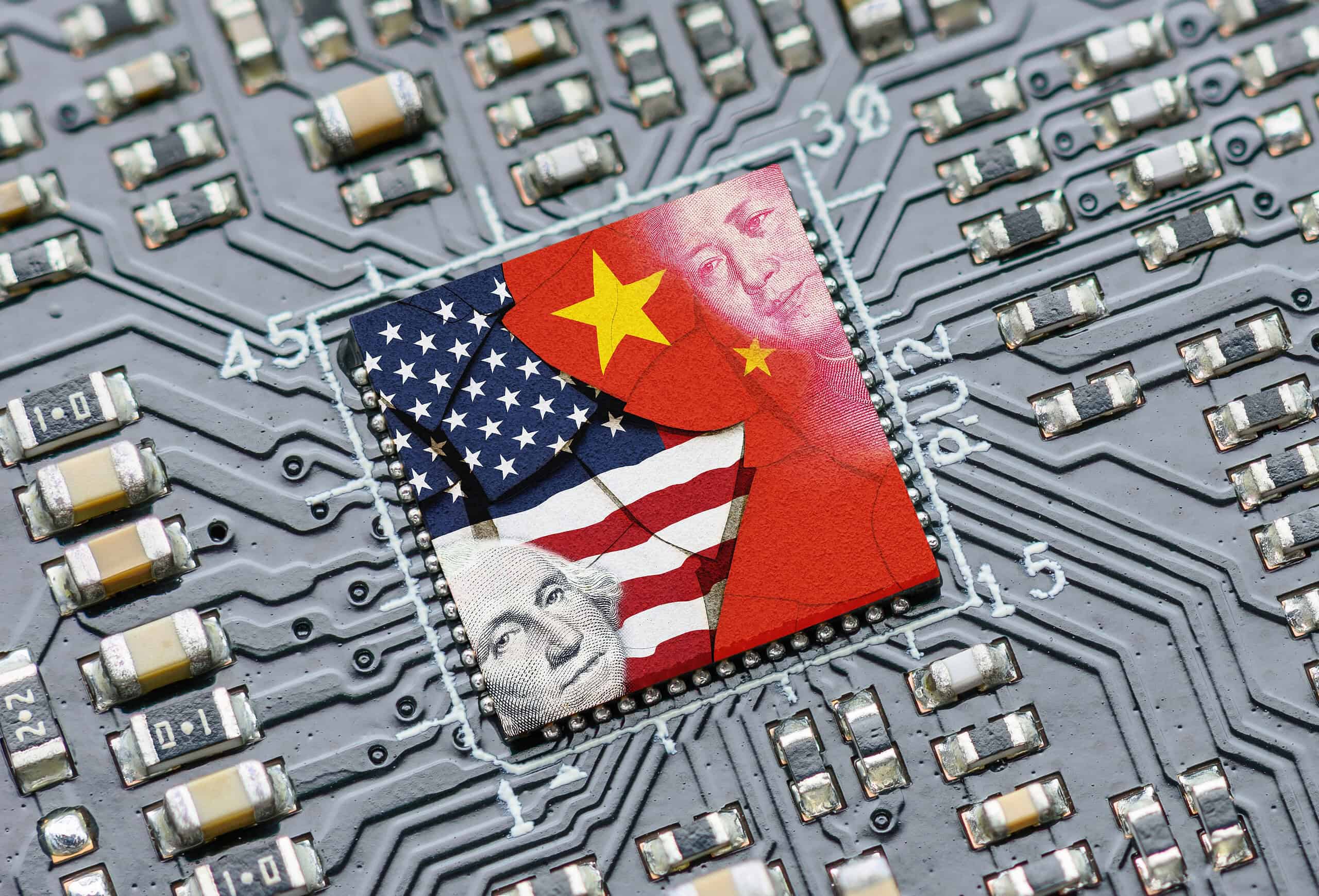
The most visible battleground in the AI competition is the semiconductor industry. Advanced microchips are the essential hardware for training and running powerful AI models, and the US has sought to use its dominance in chip design to slow China's progress.
In October 2022, the US implemented a "chokepoint" strategy, enacting sweeping export controls to restrict China's access to high-end AI chips (like those from Nvidia), advanced chip design software, and the sophisticated equipment needed to manufacture them (Source 1, 8). The policy's goal is to "strangle" China's ability to develop advanced AI for both commercial and military purposes, citing China's military-civil fusion strategy as a key justification (Source 1).
While these controls have created short-term disruptions for Chinese AI firms, they have also triggered significant unintended consequences:
* **Economic Blowback for US Firms:** The Chinese market is critical for American chipmakers. In 2024, China represented 24% of the $631 billion global semiconductor market, with US firms supplying over half of its demand (Source 1, 4). Economic models project that a full decoupling from China could cost US semiconductor firms **$77 billion in lost sales** in the first year, slash R&D investment by **$14 billion**, and lead to the loss of over **80,000 direct industry jobs** and nearly 500,000 downstream jobs in the US economy (Source 1, 3, 4). Companies like Nvidia have seen their market share in China plummet from 95% to 50% (Source 9). * **Accelerating Chinese Self-Sufficiency:** The sanctions have been interpreted in Beijing as a campaign of technological containment, spurring a massive state-funded drive for indigenous innovation and self-reliance (Source 5, 9). China is employing "design-out" strategies to replace US tech with domestic alternatives and "design-around" strategies to develop novel technologies that bypass controlled Western methods (Source 6). * **Shifting Market Dynamics:** Despite sanctions, companies like Huawei have become more resilient, increasing their global market share for telecom equipment from 29% in 2018 to 31% by 2024 (Source 10). Furthermore, while blocked from the highest-end chips, China is on track to monopolize the market for mature-node "legacy" chips—essential for cars, medical devices, and appliances—controlling over 45% of this market by 2026 and creating new dependencies (Source 8).
## Corporate and Academic Impacts
The escalating rivalry is reshaping the corporate and academic landscapes. US tech companies face a direct hit to their revenues and are navigating unpredictable policy shifts, making long-term planning difficult (Source 5, 9). Their Chinese counterparts, cut off from top-tier chips, face pressure to demonstrate commercial viability quickly with less advanced hardware and a thinner investor base (Source 9).
The academic world, once a bastion of open collaboration, is also feeling the strain. The AI research community is global and highly interconnected. Nearly half (47%) of all top AI researchers worldwide were born or educated in China, and many play a significant role in US-based AI development (Source 2). Cross-border investments and research partnerships, such as those between US firms and Chinese universities, are now viewed through a national security lens, threatening to fragment the global talent pool and slow overall scientific progress (Source 1).
## The Geopolitical Stakes
The US-China AI competition is fundamentally a contest over the future of global power and influence. The two nations are pursuing divergent strategies that reflect their unique strengths and goals.
* **The US Strategy:** The US is focused on achieving Artificial General Intelligence (AGI) and maintaining its lead in frontier, closed-source models. It leverages its deep capital markets to pour hundreds of billions into AI infrastructure, aiming to create dependencies on its advanced technology and maintain its military edge with an "AI-first" warfighting force (Source 1, 3, 7). * **The China Strategy:** China is pursuing a diffusion model, prioritizing the real-world application of AI to boost its industrial economy. It champions open-source models, which are cheaper and diffuse more rapidly, making them attractive to developing nations in the Global South. This approach, combined with AI diplomacy through infrastructure and training, aims to build an alternative, state-centric international order (Source 2, 9, 10).
This strategic divergence risks fracturing the global technology landscape into two spheres of influence—a "Silicon Curtain" separating a US-led bloc from a China-led one. Such a split would end the era of universal technology standards and prioritize national security over market efficiency, likely increasing costs and slowing innovation for everyone (Source 8).
## Future Scenarios: Collision or Coexistence?
The trajectory of the US-China AI rivalry is not predetermined. Several potential futures could emerge from the current standoff.
1. **Escalating Competition:** The "arms race" narrative could become a self-fulfilling prophecy, leading to a "race to the bottom" where safety, ethics, and stability are sacrificed for perceived strategic advantage. This path increases the risk of miscalculation and conflict, particularly as AI is integrated into military command and control systems (Source 2, 3). 2. **A Fractured Tech World:** The current path of technological decoupling could solidify into a permanent "Silicon Curtain." This would create two distinct, less efficient, and potentially incompatible technological ecosystems, forcing other nations to choose sides and creating new geopolitical fault lines (Source 8). 3. **Competitive Coexistence and Collaboration:** A third path involves managing the competition while fostering collaboration in areas of mutual interest. Experts advocate for establishing bilateral dialogues on AI safety, creating common governance standards, and forming a global coalition to ensure AI progresses in a safe and fair manner. Jointly tackling global challenges like climate change and disease with AI could reshape the technology's perception from a weapon to a tool for shared progress (Source 2).
## Conclusion
The US-China AI competition is far more complex than a simple "arms race." It is a multifaceted rivalry driven by distinct national priorities, characterized by deep economic and academic interdependence, and waged on new battlegrounds like semiconductor supply chains and data center energy consumption.
While the US strategy of imposing technological chokepoints has created hurdles for China, it has also damaged US economic interests and galvanized Beijing's resolve to achieve technological sovereignty. The divergent paths—America's pursuit of frontier AGI versus China's focus on industrial diffusion—are setting the stage for a long-term geopolitical contest for influence.
The critical question is whether this intense competition will spiral into a destabilizing conflict or if both nations can find a way to manage their rivalry while cooperating to mitigate the profound risks and unlock the immense benefits of artificial intelligence for all of humanity. The choices made today will not only determine the technological leader of tomorrow but also shape the landscape of global security and progress for decades to come.