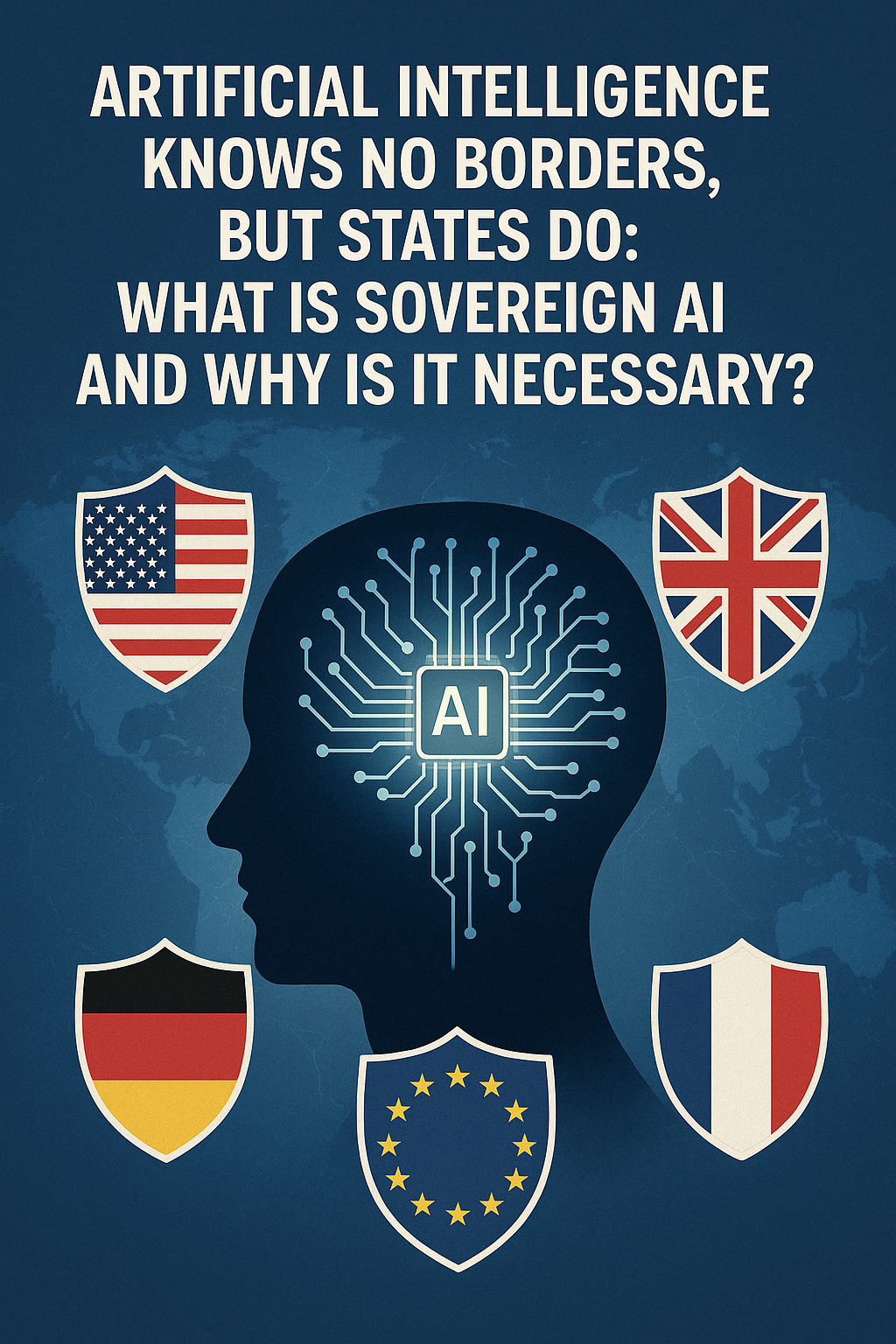
# The New Arms Race: Charting the Global Contest for Sovereign AI
**May 1, 2026** — A new global race is underway, but this one is not for territory or nuclear arms. It is a contest for computational power, data control, and digital autonomy. Nations worldwide are now locked in a strategic competition to achieve **Sovereign AI**, a term that has rapidly moved from the lexicon of technologists to the top of national security agendas. This race is driven by the recognition that artificial intelligence is a foundational pillar of modern economic power, national security, and cultural identity. As governments channel billions into this new frontier, the geopolitical landscape is being fundamentally reshaped, with nations vying to control their own digital destinies and avoid overreliance on the handful of corporate and state superpowers that currently dominate the AI landscape.
## What is Sovereign AI?
Sovereign AI refers to a nation's capacity to develop, deploy, and govern artificial intelligence systems using its own infrastructure, data, and talent. It represents a strategic push for self-sufficiency across the entire AI value chain, moving beyond simply using AI tools developed elsewhere to controlling the means of their creation and operation. This national imperative is motivated by the desire to secure economic dividends, protect against geopolitical risks, and ensure that AI technology reflects a country's unique cultural values and legal standards.
The core components of a sovereign AI strategy include:
* **Sovereign Infrastructure:** This involves building and controlling the physical hardware necessary for advanced AI, including domestic data centers, sovereign cloud platforms, and massive clusters of GPUs, often called "AI factories." * **Sovereign Data:** Nations are focused on training AI models using their own local datasets. This ensures that sensitive information remains within national borders, complying with privacy laws like GDPR, and allows for the creation of models attuned to local languages, dialects, and cultural contexts. * **Sovereign Models and Talent:** The goal is to develop an indigenous workforce capable of building, customizing, and managing AI models, from large language models (LLMs) to specialized applications. This may involve creating proprietary models from scratch or fine-tuning open-source models with local data.
The pursuit of sovereign AI is driven by a convergence of powerful motivations. Economically, AI is projected to generate trillions in productivity gains, and nations are determined to capture this value domestically. From a security perspective, relying on foreign AI providers creates vulnerabilities to service disruptions, supply chain pressures, and geopolitical leverage. Furthermore, by developing their own AI, countries can ensure that these powerful systems are governed by and aligned with national laws and ethical principles, fostering public trust and regulatory compliance.
## Leaders in the Sovereign Race
While the United States and China remain the dominant forces in AI development, a growing cohort of "middle powers" are making significant and strategic investments to build their own capabilities. The global map of sovereign AI is rapidly being redrawn.
The **United Arab Emirates (UAE)** and **Japan** have emerged as leaders in disclosed investment, collectively accounting for over two-thirds of global spending on sovereign AI initiatives. The UAE's National Strategy for Artificial Intelligence 2031 underpins its ambition to become a global AI hub, supported by secure data infrastructure like the Abu Dhabi Sovereign AI Cloud. Japan is bolstering its capacity with the ABCI 3.0 supercomputer, one of the world's most powerful open-access AI platforms, and is collaborating with NVIDIA to upskill its workforce.
In Europe, several nations are pursuing distinct strategies. **France** is championing a "trusted cloud" strategy, which provides a "cloud de confiance" label to ensure protection from foreign surveillance. **Germany** has launched the Sovereign Open Source Foundation Models (SOOFI) initiative to create a powerful, adaptable open-source AI model. Other European countries are focusing on linguistic sovereignty; **Switzerland** has developed Apertus, a multilingual model trained on over 1,000 languages, while **Poland** has introduced PLLuM to master the complexities of the Polish language.
Beyond Europe, other nations are making major moves. **Canada** has committed $2 billion to its Sovereign AI Compute Strategy to provide researchers and businesses with access to high-powered computing. **India** has approved the IndiaAI Mission with a budget of roughly $1.25 billion, aiming to build a self-reliant AI ecosystem by provisioning over 10,000 GPUs and creating indigenous foundational models tailored to the nation's linguistic diversity. The **United Kingdom** has established a dedicated sovereign AI unit and a state-backed fund to invest in homegrown AI companies. A common thread unites these diverse efforts: a heavy focus on infrastructure, with nearly 60% of all sovereign AI projects centered on building data centers, supercomputers, and GPU clusters.
## Geopolitical Implications and the Sovereignty Trap
The race for sovereign AI is fundamentally redrawing the lines of state power and international relations. AI capability is no longer just an economic advantage; it is a critical component of a nation's ability to project strategic influence, deliver public services, and make independent decisions. This has led to intense competition fueled by growing geopolitical mistrust. The rivalry between the United States, with its private-sector-led innovation model, and China, with its state-directed approach, is compelling other nations to hedge against dependency on either superpower.
However, the pursuit of complete AI self-sufficiency—a kind of digital autarky—is fraught with peril. For most countries, the immense cost and technical expertise required to replicate the entire AI supply chain, from semiconductor fabrication to frontier model development, is simply out of reach. This has led analysts to warn of a "sovereignty trap," where a nation's attempt to achieve total control results in isolation from the global innovation ecosystem, ultimately weakening its competitiveness and security.
The more pragmatic and effective strategy emerging is one of **strategic interdependence**. This approach recognizes that while full independence is impractical, nations can still expand their agency. The goal is to build essential domestic capabilities—such as secure data infrastructure and customized AI models for critical sectors like healthcare and defense—while ensuring access to global frontier AI models and compute resources. This involves creating open, interoperable systems to avoid vendor lock-in, aggregating national demand to influence global providers, and fostering a skilled domestic workforce. In this model, sovereignty is not about building walls but about securing the power to engage with the global ecosystem on one's own terms.
## What's at Stake: Economic and Security Imperatives
The stakes in the sovereign AI race are incredibly high, spanning economic prosperity, national security, and cultural preservation. Economically, nations that lead in AI development and adoption will capture the lion's share of the technology's multi-trillion-dollar economic dividend. The global opportunity for sovereign AI infrastructure alone is estimated at $1.5 trillion. Countries that fail to invest risk becoming mere consumers of foreign technology, ceding economic value and innovation potential to global tech giants.
The security imperatives are just as critical. In an era of increasing geopolitical volatility, dependency on foreign AI for critical infrastructure, public services, or national defense is a significant strategic vulnerability. A disruption in access—whether due to commercial disputes, sanctions, or conflict—could have paralyzing effects. Sovereign AI provides a crucial fallback, ensuring the continuity of essential services and protecting sensitive national data from foreign surveillance or manipulation.
Finally, there are profound cultural stakes. AI models are not neutral; they reflect the data on which they are trained, embedding the biases, values, and norms of their creators. Nations are pursuing sovereign AI to ensure these powerful systems speak their languages, understand their cultural contexts, and operate in alignment with their ethical and legal frameworks. Without this capability, countries risk adopting AI that is misaligned with their societies, leading to a form of digital colonialism where foreign values are inadvertently imported and amplified.
## Conclusion
The global push for sovereign AI is more than a technological trend; it marks a geopolitical reset in the digital age. Driven by a desire for economic competitiveness, national security, and cultural autonomy, nations are fundamentally rethinking their relationship with technology. While the path to complete self-sufficiency is a "trap" for most, the pursuit of strategic independence is reshaping state priorities and driving unprecedented investment in domestic compute power, data infrastructure, and talent. The race is not about isolation but about securing a seat at the table in an AI-driven world. The nations that successfully navigate this complex balancing act—building domestic strengths while strategically engaging with the global ecosystem—will define the future of power, prosperity, and sovereignty in the 21st century.