# The New Cold War: How the US-China AI Race is Reshaping Global Power
A new global rivalry is defining the 21st century. It is not a contest of traditional armies or sprawling empires, but a high-stakes race for technological supremacy fought in silicon and software. The United States and China are locked in a struggle for dominance in artificial intelligence (AI), a technology poised to revolutionize economies, redefine warfare, and ultimately determine the future balance of global power. This is the new Cold War, and its outcome will shape the world for generations to come.
## The Stakes of Supremacy
The contest for AI leadership is not merely about creating smarter smartphones or more efficient algorithms. It is a competition for the commanding heights of the global economy and military might. For Beijing, the goals are explicit and ambitious. China's national strategy aims to integrate AI into 90% of its economy by 2030, transforming it into a $100 billion industry that could generate over $1 trillion in value for adjacent sectors like manufacturing, healthcare, and transportation.
This economic vision is matched by a military one. Both Washington and Beijing recognize that the nation that masters AI will hold a decisive strategic advantage on the battlefield. From autonomous drones and intelligent command systems to predictive logistics and cyber warfare, AI promises to change the character of conflict itself. The stakes, therefore, could not be higher: the winner of the AI race will likely set the rules for the international order, enjoying unparalleled economic prosperity and military security.
## Competing National Strategies
The US and China are pursuing starkly different paths to AI dominance, reflecting their distinct political and economic systems.
China's approach is state-driven and centrally coordinated. Under its "AI+ action plan," Beijing is pouring vast sums of capital into the sector. Phase 3 of its National Integrated Circuit Industry Investment Fund, known as the "Big Fund," has mobilized US$47 billion, while a new National Venture Capital Guidance Fund aims to steer up to US$144 billion into "hard tech" sectors like AI and semiconductors. The core objective is technological self-reliance. Through its "military-civil fusion" policy, the government ensures that advancements in the private sector directly serve the modernization of the People's Liberation Army (PLA). A key part of this strategy is to build a fully indigenous AI ecosystem—from hardware to software—to break its dependence on American firms like Nvidia, Google, and Intel. To accelerate adoption, China is also championing an open-source approach for many of its AI models, hoping to build a global community of developers around its technology.
The United States, in contrast, relies on its dynamic, decentralized private sector. It currently holds what has been described as a "fragile first-mover advantage," leading in the development of the most advanced "frontier" AI models and the complex engineering required to build them. This innovation is driven by fierce competition among its tech giants and a vibrant startup culture. The US government's primary strategic lever has been to play defense, implementing a "choke point" strategy designed to slow China's progress by restricting its access to the critical technologies needed to train and run advanced AI.
## The Semiconductor Battleground
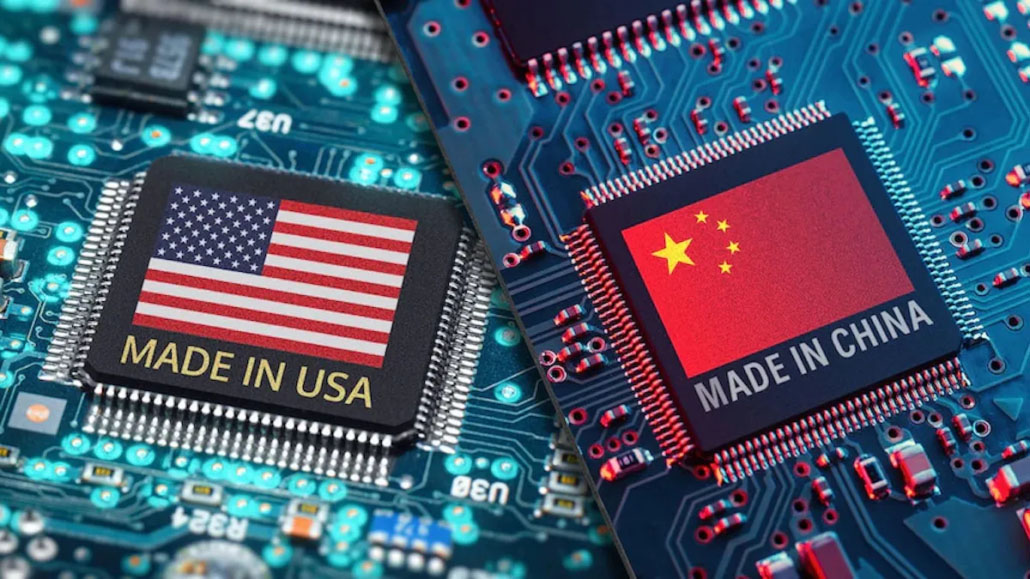
At the heart of the AI race lies the battle for semiconductors. These tiny, intricate chips are the essential hardware that powers AI, and control over their supply chain is a matter of national security.
The US has made this its primary front in the tech war. Washington has implemented a series of increasingly sophisticated export controls aimed at preventing China from acquiring the most advanced AI chips and the equipment needed to manufacture them. This policy, however, has become a complex balancing act. In late 2025, the Trump administration signaled a slight easing, permitting the sale of certain high-performance chips, like Nvidia's H200, to China under a strict "case-by-case review" policy that became official in January 2026.
These sales are not a free-for-all. Exporters face a mountain of red tape, including requirements to certify the chip's exact performance, prove that sales to China will not create shortages in the US market, and conduct extensive due diligence on their customers. In a significant move to prevent circumvention, companies must now identify the ultimate remote end-users of their products in China, a measure aimed at stopping Chinese firms from accessing powerful chips through cloud computing services. Alongside these controls, a 25% tariff has been placed on advanced AI chips imported for purposes outside the US technology supply chain. This nuanced policy has drawn sharp criticism from members of the US Congress, who are pushing for even tighter restrictions and greater oversight through proposed legislation like the "AI Overwatch Act."
Faced with this technological blockade, China has responded with a massive, state-backed push for semiconductor independence. The "choke point" strategy has only intensified Beijing's resolve. Its top industrial priority is now the localization of the entire semiconductor supply chain, with a goal for new fabrication plants to use 50% domestically made tools by 2028. At the center of this effort is Huawei, which anchors a sprawling ecosystem of nearly two thousand companies working to overcome US sanctions. Chinese foundries like SMIC are making steady progress, producing advanced 7-nanometer chips with existing equipment, while Huawei builds a massive new manufacturing complex in Shenzhen. China's reaction to the limited availability of US chips has been cautious, with reports of temporary import halts, suggesting a strategy of both skepticism and a determined focus on building its own capabilities.
## The Race to 'Intelligentized' Warfare
The implications of the AI race are most stark in the military domain. Both nations are aggressively pursuing the "intelligentization" of their armed forces.
China's goal is to achieve a fully "intelligentized" PLA by mid-century. Its strength lies in the rapid adoption and mass production of AI-enabled hardware. The PLA is already fielding hundreds of truck-launched drone swarms, developing "loyal wingman" aircraft to accompany crewed fighters, and experimenting with uncrewed naval vessels. This is made possible by its world-leading commercial drone industry and the government's civil-military fusion policy, which seamlessly transfers technology to the armed forces. Beijing is also developing sophisticated "command brains"—AI systems designed to coordinate autonomous swarms and optimize battle plans at machine speed.
The US military, meanwhile, is working to maintain its qualitative edge. The Pentagon is moving beyond using AI as a simple analytical tool and toward developing it as an "agentic" partner capable of independent planning, reasoning, and execution. This includes "agentic alerting" systems that can autonomously detect threats like hypersonic missiles from streams of sensor data, and "agentic planning" tools that can generate and validate complex military courses of action in minutes. The US advantage lies in its superior frontier AI models and access to petabytes of high-quality operational data gathered over decades of global operations. The challenge is a doctrinal one: shifting from a "human-in-the-loop" model to a "commander-on-the-loop" approach, where leaders set intent and machines execute at a pace no human can match.
## Alliances and the Global Divide
This technological contest is forcing nations around the world to choose sides. The US is actively working to transform its traditional alliances, like NATO and the AUKUS pact with the UK and Australia, into "agentic coalitions." The goal is to integrate allies' systems to ensure seamless interoperability and maintain a collective "decision advantage" in a future conflict fought at machine speed. Washington is also pressuring partners to adopt similar export controls to prevent critical technology from being transshipped to China.
China, in turn, is leveraging its position as the world's largest exporter of military drones and its open-source AI strategy to build influence and create technological dependencies. For countries across the Global South and beyond, the choice of whether to align with the American or Chinese technology ecosystem is becoming a defining feature of their foreign policy, with profound implications for their economic and security futures.
## Prospects for Cooperation or Conflict
The unchecked competition in military AI dramatically increases strategic risks, heightening the possibility of an armed conflict between two nuclear-armed powers. The sheer speed of AI-driven decision-making could compress crisis timelines, while the proliferation of autonomous weapons systems introduces new vectors for escalation. As AI systems become more central to military command and control, they also become high-value targets for cyberattacks, data poisoning, and manipulation, creating frightening new vulnerabilities.
Despite the intense rivalry, there are faint glimmers of a shared interest in risk reduction. Policymakers on both sides have acknowledged the need for norms and best practices for the responsible development of military AI. Diplomatic engagement, including potential confidence-building measures, is seen as vital to prevent miscalculation. In the near term, Washington appears focused on enforcing existing rules rather than imposing new ones, a move likely intended to stabilize trade talks and manage tensions.
However, the fundamental conflict remains. The race for AI supremacy is a zero-sum game in the eyes of many in both Washington and Beijing. As long as technological dominance is seen as the ultimate guarantor of national security and prosperity, the prospects for deep and lasting cooperation are slim. The world is holding its breath as the two giants of the 21st century navigate this new, technology-fueled Cold War, a contest whose outcome is anything but certain.